Cookie Consent Options
Oracy
“The art of conversation is the art of hearing as well as of being heard.”— William Hazlitt
Our Vision for Oracy
At Broadway Junior School, we believe every child deserves the confidence, skill, and opportunity to speak and listen with purpose. Our vision is to build a culture where oracy is woven into the heart of learning, enabling all pupils to become articulate, thoughtful, and empowered communicators—ready to thrive in school and beyond. We aim to create classrooms where every voice is valued and every child is equipped to express themselves clearly, respectfully, and creatively. Through rich dialogue, exploratory talk, performance, and discussion, we nurture pupils who can question, reason, collaborate, and reflect.
What is 'Oracy'?
Oracy is the ability to speak clearly, confidently, and appropriately in different situations. Just like reading and writing, oracy is a vital skill that helps children succeed both in school and in life. It involves not only speaking fluently but also listening carefully, building ideas collaboratively, and presenting thoughts effectively.
Broadway Junior School is a Voice 21 School
This marks our commitment to enriching our children's educational journey through the power of oracy. At Broadway Junior School, we believe every child deserves the opportunity to find their voice—and be heard.
As a Voice 21 School, we are now part of a national network of schools that are dedicated to embedding high-quality oracy education across the curriculum. This means that our children will benefit from opportunities to:
-
Develop greater confidence in speaking
-
Improve their vocabulary and communication skills
-
Work better in groups and collaborate respectfully
-
Be more engaged in their learning
We believe that oracy is a powerful tool for learning; by teaching pupils to become more effective speakers and listeners. We empower them to better understand themselves, each other and the world around them.
It is also empowers pupils to find their voice and to succeed in school and life. Through a high quality oracy education, children learn through talk and to talk. This is when they develop and deepen their subject knowledge and understanding. Through talk in the classroom, which has been planned, designed, modelled, scaffolded and structured to enable them to learn the skills needed to talk effectively.
Oracy as a Foundation for Learning and Inclusion
At Broadway Junior School, oracy is central to our approach to teaching, learning and inclusion. As a Voice 21 School, we recognise that the ability to speak, listen, communicate and articulate ideas is fundamental to children's academic achievement, personal development and sense of belonging. Oracy is not an additional activity; it is embedded throughout our curriculum and underpins how children access learning, develop understanding, express themselves and build positive relationships.
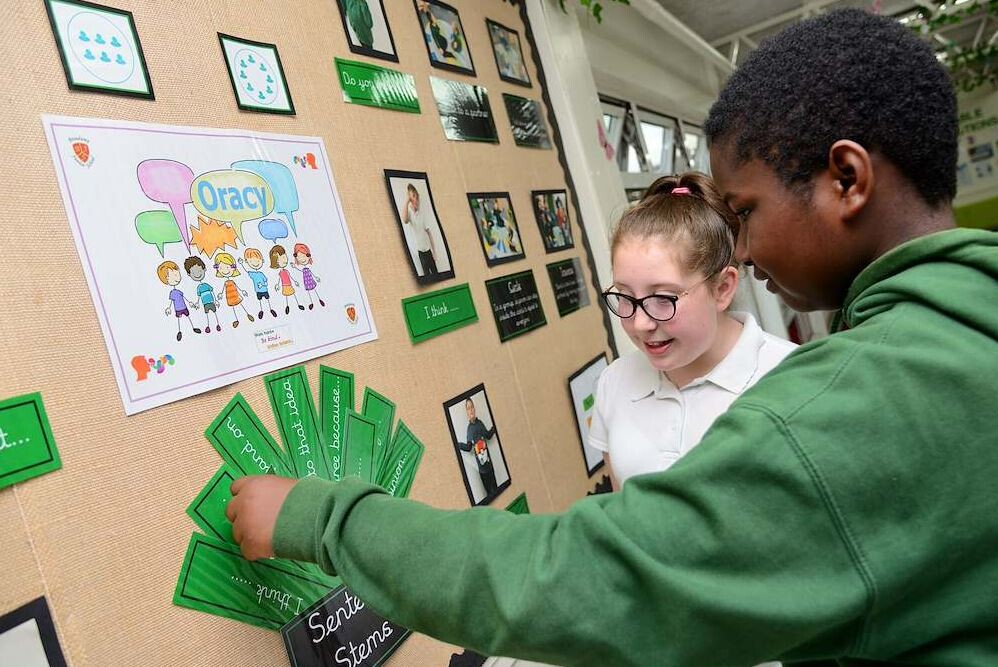
We use Voice 21 strategies to develop the four strands of oracy: physical, linguistic, cognitive and social and emotional. These are woven into everyday classroom practice through carefully structured talk, explicit teaching of vocabulary, partner and group discussions, sentence stems, talk tactics, collaborative problem-solving, oral rehearsal and opportunities for pupils to explain, justify, challenge and build on one another's ideas. Teachers model effective speaking and listening, establish clear expectations for discussion and create purposeful opportunities for every child to contribute. Our approach supports children to become confident communicators who can listen actively, respond thoughtfully and adapt their language for different audiences and purposes.
Oracy is a core element of inclusion because every child deserves the opportunity to have their voice heard, contribute meaningfully and access the same ambitious curriculum. We recognise that children enter school with different experiences, vocabulary, language skills and levels of confidence. Some pupils may require additional support to process information, organise their thoughts, understand new vocabulary or communicate their ideas. By explicitly teaching and scaffolding talk, we reduce barriers to learning and ensure that communication difficulties or a lack of confidence do not prevent pupils from participating or demonstrating what they know.
Inclusive oracy strategies include pre-teaching key vocabulary, using visual prompts, providing sentence stems and structured discussion frameworks, allowing thinking time, rehearsing responses with a partner before sharing with the class, and revisiting language through repetition and modelling. Teachers adapt the level of scaffolding according to pupils' individual needs, including those with SEND, speech, language and communication needs and pupils who may be disadvantaged by limited prior experiences. Alternative ways of contributing are encouraged where appropriate, while pupils are supported to develop their spoken language and independence over time.
Through these approaches, oracy supports pupils to access complex texts, deepen comprehension, develop subject-specific vocabulary, reason mathematically, explain scientific thinking and articulate their understanding across the foundation curriculum. It also strengthens relationships, promotes respectful disagreement, develops empathy and ensures that different perspectives are valued. Structured talk enables teachers to identify misconceptions, assess understanding in the moment and respond to pupils' needs through adaptive teaching.
At Broadway, we want every child to feel that their voice matters. By embedding Voice 21 principles across the curriculum, we aim to ensure that all pupils, regardless of starting point or individual need, can participate, achieve, develop confidence and become effective communicators. Oracy is therefore both a means of improving learning and a vital part of our commitment to equity, belonging and inclusion.